
The Marion B. Brechner First Amendment Project, part of the Brechner Center for the Advancement of the First Amendment, is a non-profit, non-partisan organization dedicated to current and contemporary issues affecting the First Amendment freedoms of speech, press, thought, assembly and petition.
Congress shall make no law respecting an establishment of religion, or prohibiting the free exercise thereof; or abridging the freedom of speech, or of the press; or the right of the people peaceably to assemble, and to petition the government for a redress of grievances.

David Cuillier Comments on Lack of Oversight for Distribution of Funds to Anti-Abortion Pregnancy Centers
December 13, 2023


Jane Bambauer Comments on Lawsuit Against Meta Alleging Its Social Media Platforms Exploit Young People
November 3, 2023

Jane Bambauer Comments on Higher Education First Amendment Concerns and Meta Lawsuit
November 1, 2023

 ;
;
New from @ProfClayCalvert:
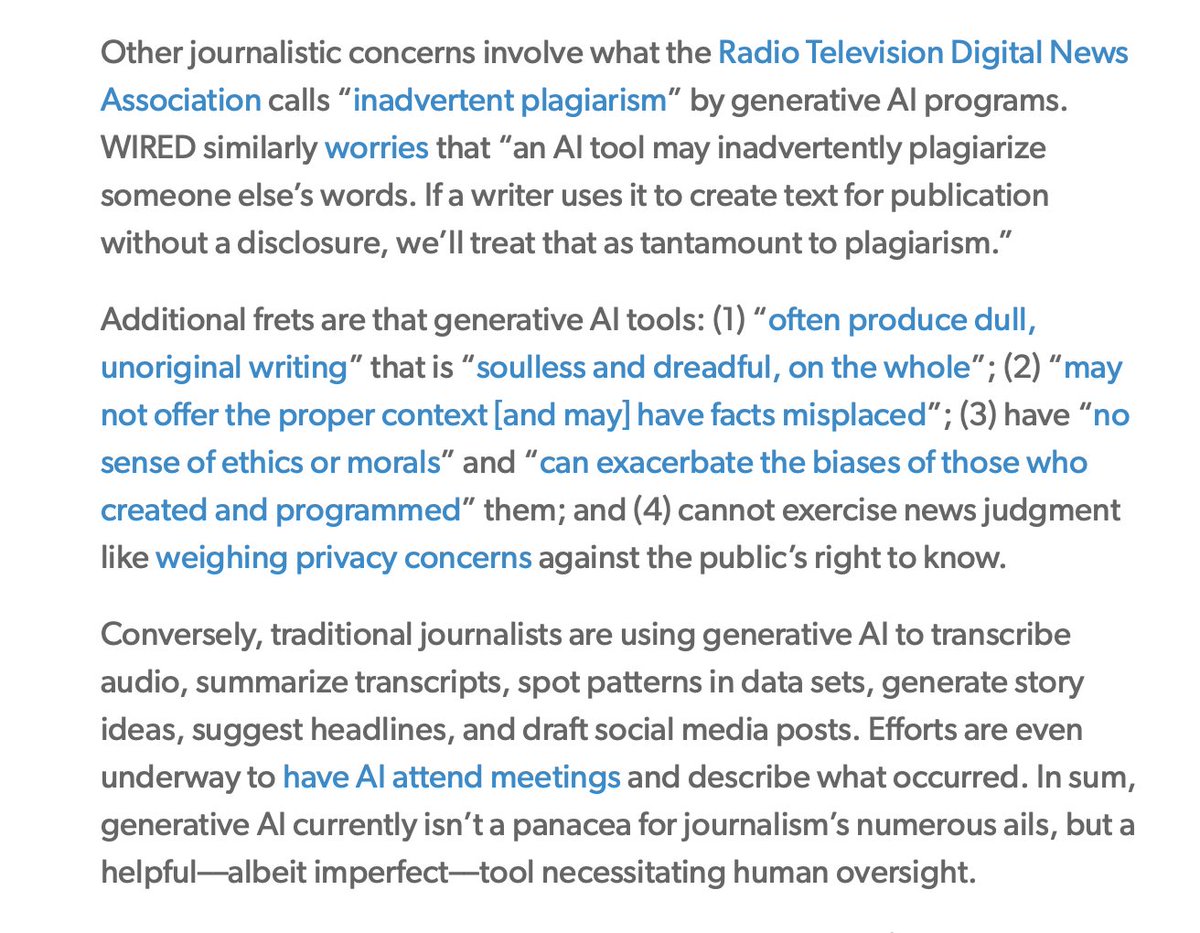
Generative AI currently isn’t a panacea for journalism’s numerous ails, but a helpful––albeit imperfect––tool necessitating human oversight.
READ MORE:
Some thoughts today on #Journalism & #GenAI for @AEItech @AEI . . . https://www.aei.org/technology-and-innovation/journalism-and-generative-ai-exploring-limitations-and-apprehensions-within-the-news-industry/ . . . with concerns from @RTDNA @WIRED @NPR @AP
Some thoughts for @AEItech re #SCOTUS #FirstAmendment decision . . . Judicial Rulemaking and Lucidity: Justice Barrett’s First Amendment Opinion in Lindke v. Freed
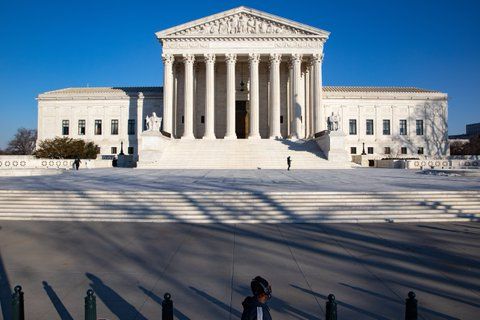
Judicial Rulemaking and Lucidity: Justice Barrett's First Amendment Opinion in Lindke v. Freed
Fashioning constitutional rules isn’t easy; Justice Barrett and the Court deserve kudos for their efforts to establi...
www.aei.org
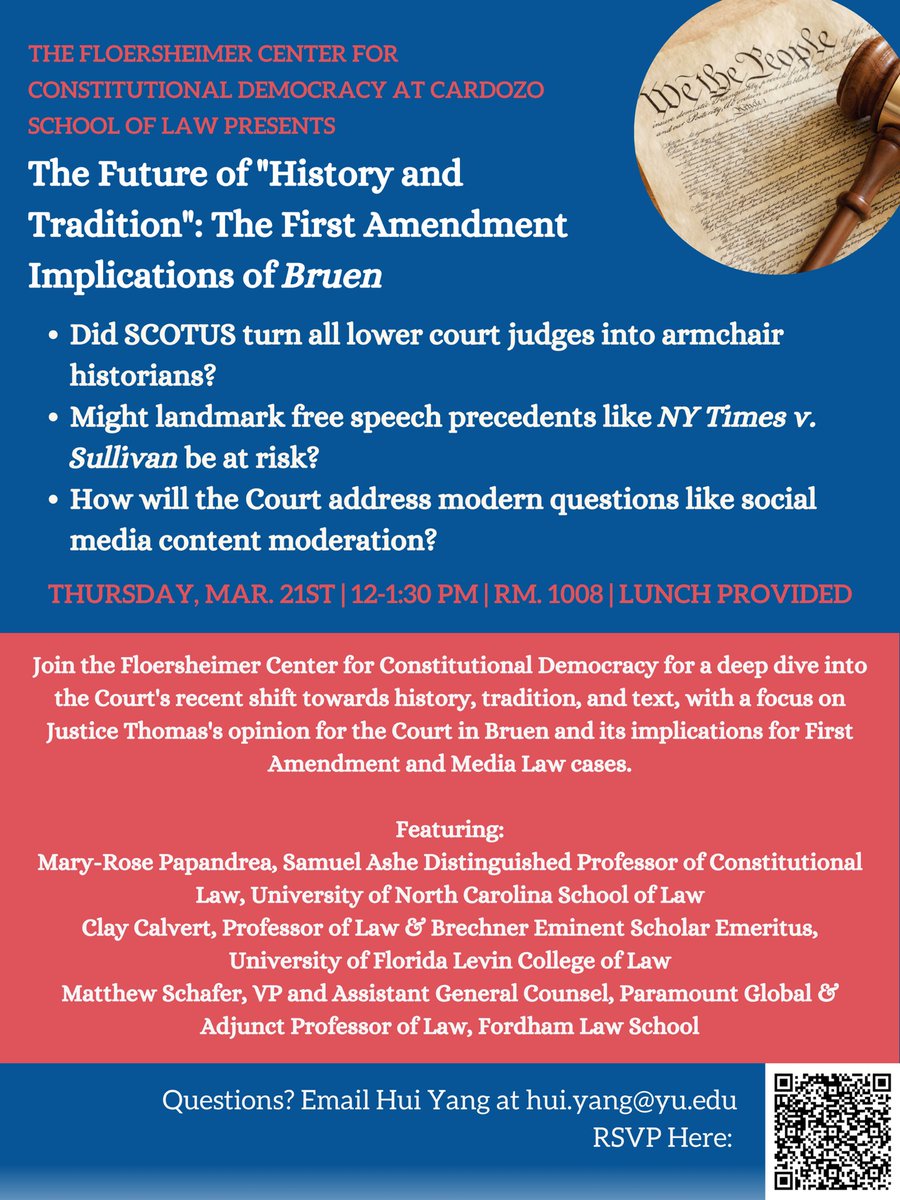
This was both as fun as it looks in the photo and truly informative and thought-provoking. Thanks so much to Mary-Rose Papandrea, @ProfClayCalvert, and @MatthewSchafer for helping us understand the future of the First Amendment and the role of history and tradition at the Court!
Thanks @michaelcpollack and @FloersheimerCtr for inviting us to @CardozoLaw to talk today about text, history, tradition and the #FirstAmendment. @MatthewSchafer @AEItech @UFLaw
NEW from @ProfClayCalvert:
Some thoughts about #SCOTUS #FirstAmendment oral arguments in #MurthyVsMissouri for @AEItech @AEI at https://www.aei.org/technology-and-innovation/persuasion-or-coercion-unpacking-oral-arguments-and-problems-in-murthy-v-missouri/

📢Please join Mary-Rose Papandrea (@unc_law), @ProfClayCalvert (@UFLaw), and @MatthewSchafer (@FordhamLawNYC) this Thursday at noon @CardozoLaw or on Zoom.
RSVP now at https://bit.ly/3TlXdmB.
Now on the @IODManny Show
10:18am - @MarcACaputo on #FloridaPrimary and #Trump rhetoric
10:38am - @asgomez1 on protests in #Cuba
10:48am - @ProfClayCalvert on #SCOTUS and the #1stAmendment
LISTEN LIVE #Sayfie
Honored to speak Thursday @CardozoLaw re #FirstAmendment and history/tradition . . . @AEItech
New from AEI Tech
@ProfClayCalvert argues that in Trump v. Anderson, the Court's concurring opinions lamenting the expansive nature of the decision portend potentially narrow decisions in forthcoming rulings on the NetChoice cases.
Read the article here:
Doing some legal lane crossing and dot connecting for @AEI @AEItech today on #SCOTUS cases and #JudicialRestraint . . . Resolving Only What’s Necessary: Bridging Constitutional Concerns in #TrumpVsAnderson with Social Media Regulation

Resolving Only What's Necessary: Bridging Constitutional Concerns in Trump v. Anderson with Social...
In Trump v. Anderson, the Court's concurring opinions lamenting the expansive nature of the decision portend potential...
www.aei.org
They are not long . . . Twoish weeks. Excellent! Go see it @wineandrosesbw 💯

"The First Amendment thus is triggered only by state action, not by private regulation of expression."
The First Amendment’s First Principle Dictates Why Social Media Platforms Must Prevail in the NetChoice Cases

The First Amendment's First Principle Dictates Why Social Media Platforms Must Prevail in the...
The bottom line is the top-level principle: Florida and Texas violate the platforms’ First Amendment rights by int...
www.aei.org
Looking forward to speaking Tuesday @WSLR965 hosted panel with Jim Lake of @TLoLawFirm & @mayerjoy of @TrustingNews in #Sarasota . . . @AEItech Forum: Media Ethics and Law

Forum: Media Ethics and Law - WSLR+Fogartyville
Tuesday, March 12, 6 p.m. | Doors open at 5:30 p.m. Free with registration. Register Here! This forum will loo...
wslr.org
My thoughts for @AEItech @AEI re: #FirstAmendment rights of social media platforms in #SCOTUS @NetChoice @ccianet cases & pushing back against common carrier arguments . . .
The First Amendment's First Principle Dictates Why Social Media Platforms Must Prevail in the...
The bottom line is the top-level principle: Florida and Texas violate the platforms’ First Amendment rights by int...
www.aei.org
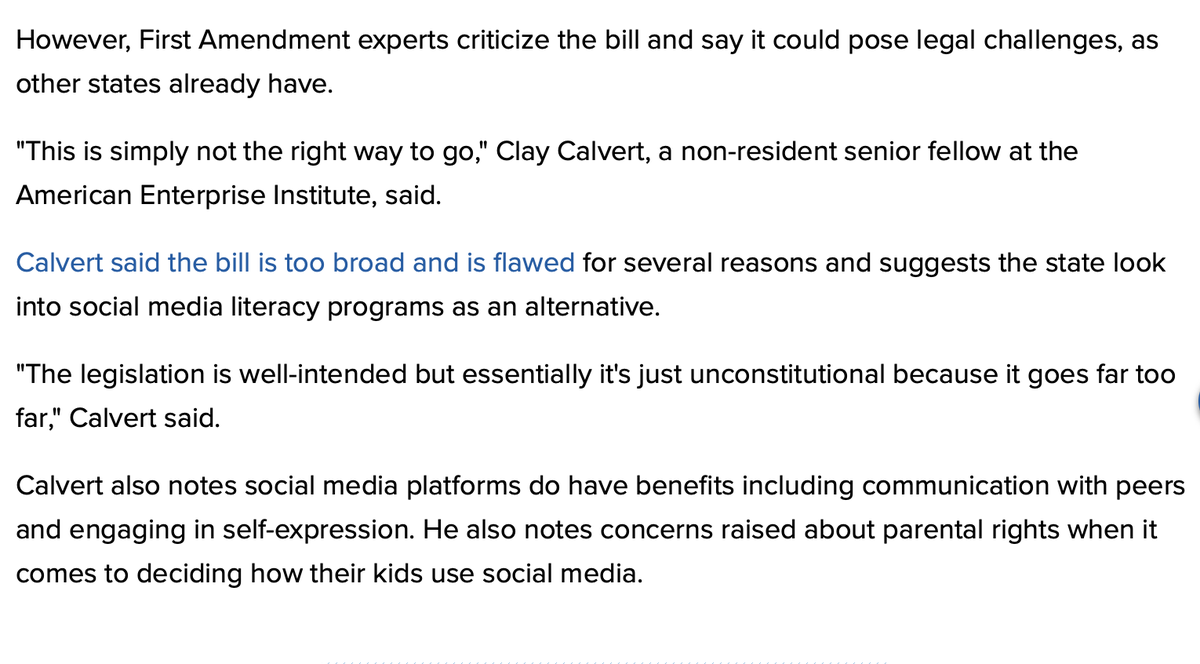
Some comments on @10TampaBay in interview with @migueloctaviotv re: Florida HB 1 social media legislation now in front of @GovRonDeSantis . . . https://www.wtsp.com/article/news/politics/florida-social-media-bill/67-d9d78336-babe-482d-b181-e5afa3d283a5 . . . @AEItech @AEI
SCOTUS delivering an overwhelming First Amendment victory in @NetChoice cases would be preferred by many, but @ProfClayCalvert @AEI addresses why the rulings could instead be narrow.
Oral arguments for the NetChoice cases happened this past week...now what?
@ProfClayCalvert speculates that "the big-picture, pro-business victory eventually should come; it just might take a little longer to get there."
Read the full article now: